






All's changed, changed utterly: A terrible beauty is born
Is it appropriate to apply the words of W.B. Yeats to a handful of pronouncements made by OpenAI? Probably not, no.
That said, few other phrases capture the scale, tragedy, and opportunity of the current moment within web design. The constant advancement of AI technology has completely reframed the limits and possibilities of our work, offering challenges in one hand and opportunities in the other. This is a period of revolution in the true sense of the word, with the sudden inadequacy of the past matched only by the bright inevitability of the future.
As one colleague in Kooba put it: This is the end and future of design as we know it.
What’s the big deal?
Drama aside, what’s actually gotten us so worked up?
In the past two weeks, OpenAI announced two transformative updates to ChatGPT. As of October 2025, ChatGPT can not only process payments using Stripe, but can also host custom-made apps. This means that brands can directly build and share their own user interfaces within ChatGPT, and can immediately sell to users without having to redirect them through their own website.
Currently, both these features are limited to a small range of pilot brands, but OpenAI will expand their scope across the next year, with the goal of creating a tool that can handle more user needs internally, rather than linking visitors outwards to other websites.
Why does this matter for my business?
The implications of this update are exciting and dramatic. If you’re a SaaS company, for example, this would allow for users to interact with your app within ChatGPT, trying out different features and exploring your user interface. And, if they enjoyed this, they could convert immediately within ChatGPT. In other words, smart brands will be able to meet high-intent prospects where they are, rather than waiting for them to arrive on their website.
The end (and beginning) of design as we know it
From a designer’s perspective, these updates present immediate challenges. The impending existence of a complete conversion pathway within ChatGPT now means that clients will need two digital solutions to market their goods and services. A conventional website solution (which itself is being changed by AI technology) and a new app solution to appear within LLMs. This will be a separate solution to solve separate user needs, not just a reskinned website.
As a first guess, I would predict that:
- Apps in ChatGPT will include more imagery and video (both of which are hard for ChatGPT to produce from scratch).
- Apps in ChatGPT will be more interactive and “feature focused”, as users will have already displayed high intent in order to access them.
- Apps in ChatGPT will feature conversational design, which users now expect within an AI platform.
- Websites will host more written content and brand messaging, which LLM apps will lack the space for.
- Apps in ChatGPT will be more modular, allowing for generative responses to be created (although this will also occur within websites to a lesser extent).
This parallel existence of AI apps and conventional websites will be a strange one. Whilst they will compete against one another for traffic, they will also allow for marketing teams to tailor their approach to two different audiences, with their app and website covering each other's blind spots. In short, both of these solutions will be complementary, competitive, and absolutely necessary for connecting with future consumers.
The future of the internet
It’s always tempting to imagine that this is the last and final iteration of the future. That as much as our world has been torn up and re-ordered, we now finally have a chance to come to terms with it and enjoy a degree of stability.
This is a fantasy. The double integration of payments and apps within ChatGPT will soon be followed by equally transformative changes elsewhere. Alphabet and Meta are no doubt planning their own responses, and both have already taken steps to entirely contain purchase journeys within their platforms. Instagram Shopping, for instance, allows for e-commerce purchases to be completed entirely within Meta’s app, and Google AI-overviews are resulting in more zero-click queries than ever before.
Ever since a small number of tech giants captured the market in the 2010s, the internet was always headed towards an oligarchic structure, with more and more traffic going to less and less websites. In economic terms, the inequality of traffic distribution (measured with a Gini coefficient) is similar to that of incomes in Kenya, India and Turkey. If we consider the “final owners” of the largest websites, we find that 49% of all traffic is “owned” by Alphabet (AKA Google).
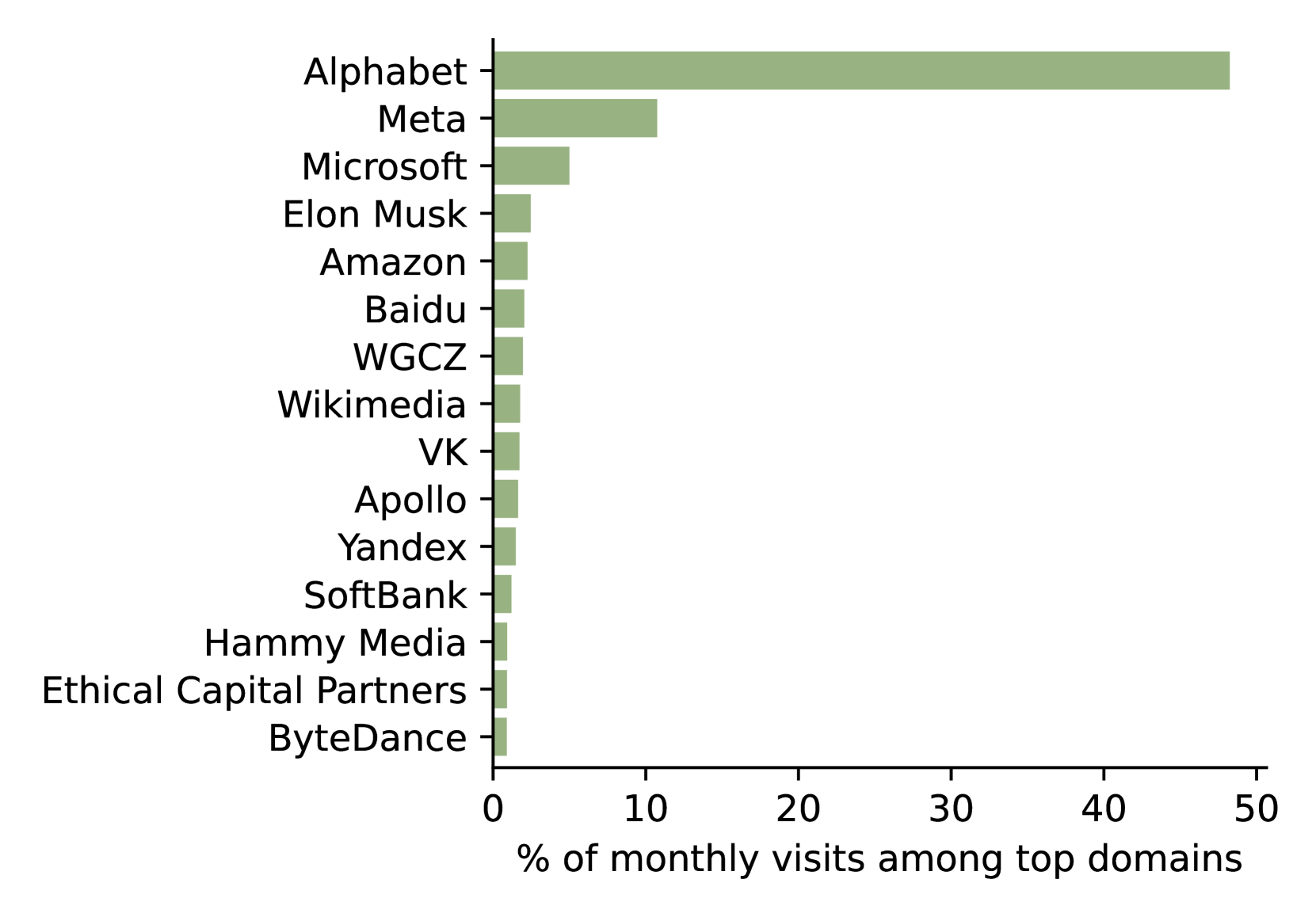
AI, rather than serving as a “giant killer”, has instead empowered these firms to pull even more traffic into channels that they retain complete control over. Rather than travelling through Google into privately controlled websites, users now gain access to the same content within Google’s AI overviews. Of course, how firms rank within these overviews will be up to Google, and presumably go to the highest bidder.
From a business perspective, all we can do is play the cards we are dealt. That means ranking higher in AI overviews, building apps for LLMs, and engaging in GEO content strategies. At Kooba, we’re already pursuing these options for clients (and for ourselves!).
If, like us, you’d rather swim than sink, then feel free to get in touch today. We’d love to discuss the AI-friendly digital strategies that suit your organisation best.