





Unless you’ve been living under a rock, it's become very clear that web design and digital marketing are undergoing a dramatic transformation. Central to this change is the introduction, and increasing importance, of AI tools such as large language models (LLMs).
With audience behaviour shifting permanently, and exciting new tools available for design and marketing teams, it's no surprise to see endless think pieces about the future of the industry.
At Kooba, we’ve already written a lot on this topic (check our Managing Director Emmet Dunne’s comprehensive overview here), but from a design perspective, it feels like something is missing. Put simply, what will the future of the internet actually look like? What will the visual consequences of this new technology be?
AI segmentation and UI design
One area of AI in web design I am particularly excited about is AI segmentation. This refers to the categorisation of visitors into personas by LLMs depending on how they interact with your website. This allows for highly personalised user journeys, without relying on third party cookies.
For designers, this also allows for the creation of persona-specific features and visual components. Rather than trying to satisfy every single user with each design feature, we can instead create a range of different assets that will be “served up” by an LLM depending on the exact preferences and needs of the user in question. This means more specialised visual experiences that better match the unique interests of each user.
Taken even further, AI could generate UX designs in real time for each individual user using prebuilt components as basic building blocks. For obvious reasons, we have some concerns about letting AI do this as of right now, but this will be something to watch in the near future.
Modular design for AI
If we assume that AI agents will be chopping and changing our work for each unique user experience, that has some immediate implications on our design choices.
As my clever colleague Claire Smith has already suggested, this makes modular “bento box” designs much more appealing, as each element is self contained and self sufficient. This means that no matter how they get rearranged, they will provide an effective experience for the end user.
This is already a principle that web designers and developers should be familiar with. Generally speaking, clients should only be provided with features that can be arranged in any combination without any decline in visual appeal or technical performance. With AI, this will be taken to its natural conclusion, with designers supplying a fully inter-compatible design system that functions perfectly no matter how it is rearranged.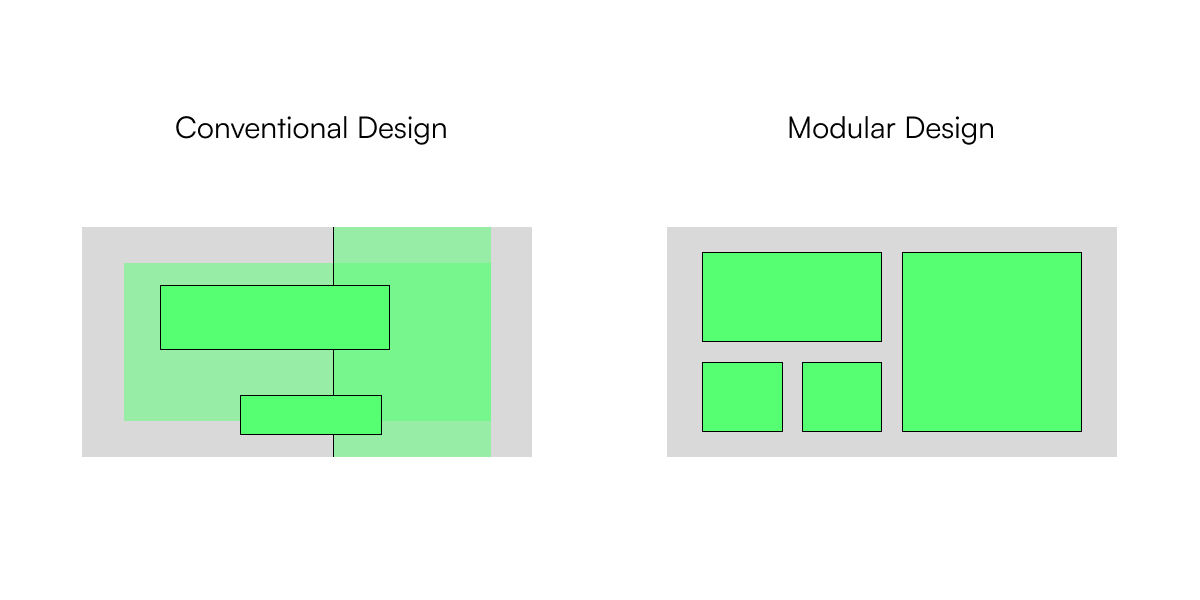
The importance of content design for GEO
AI is not only changing how websites are created and displayed, but also how they attract traffic from the wider internet. AI search overviews are already causing traffic to websites to decrease, as users have queries answered within the search engine itself. Just this week, Stripe announced that their payment platform will be integrated into ChatGPT, allowing for users to checkout directly within their chat. Ranking highly within AI tools is also becoming more important, as high interest users shift towards ChatGPT rather than Google. This process of improving LLM visibility is called generative engine optimisation (GEO).
With both of these developments, the quality of your content is becoming more important than ever. As our marketing executive Evan Farrell argued in a previous article for Kooba:
If you’re looking to build a marketing strategy around LLM rankings, your website will need to be designed as a publishing powerhouse.
This also means that the design of content formats and content pages matters even more than it once did. By designing pages that allow for clear, well-structured, and relevant content, we can ensure that your brand is mentioned by LLMs ahead of your competition. Websites will increasingly become repositories of relevant information, with their visual design reflecting this new role.
New challenges for digital designers
Digital experiences are being asked to work in new ways, and so are those who build them. In order to create websites that continue to attract and convert high-value leads, designers will need to start thinking about content, personas, and modular layouts even more than they have before.
This is something that we’ll be looking forward to, especially given the opportunity to provide more personalised, engaging, and relevant content than ever before. The future, for now, looks bright.
If you’d like to see how your digital presence could look in an AI-first world, just get in touch with us today, we’d love to talk!