






So far in 2025 we’ve seen a bit of everything in terms of UI design, especially when it comes to the digital interfaces that we love working on at Kooba.
There are several noteworthy trends, each emerging for different reasons, solving different problems, and relying on different technologies. They are all worth discussing in their own right, if only to provide a small update on the wider changes in the world of UI design.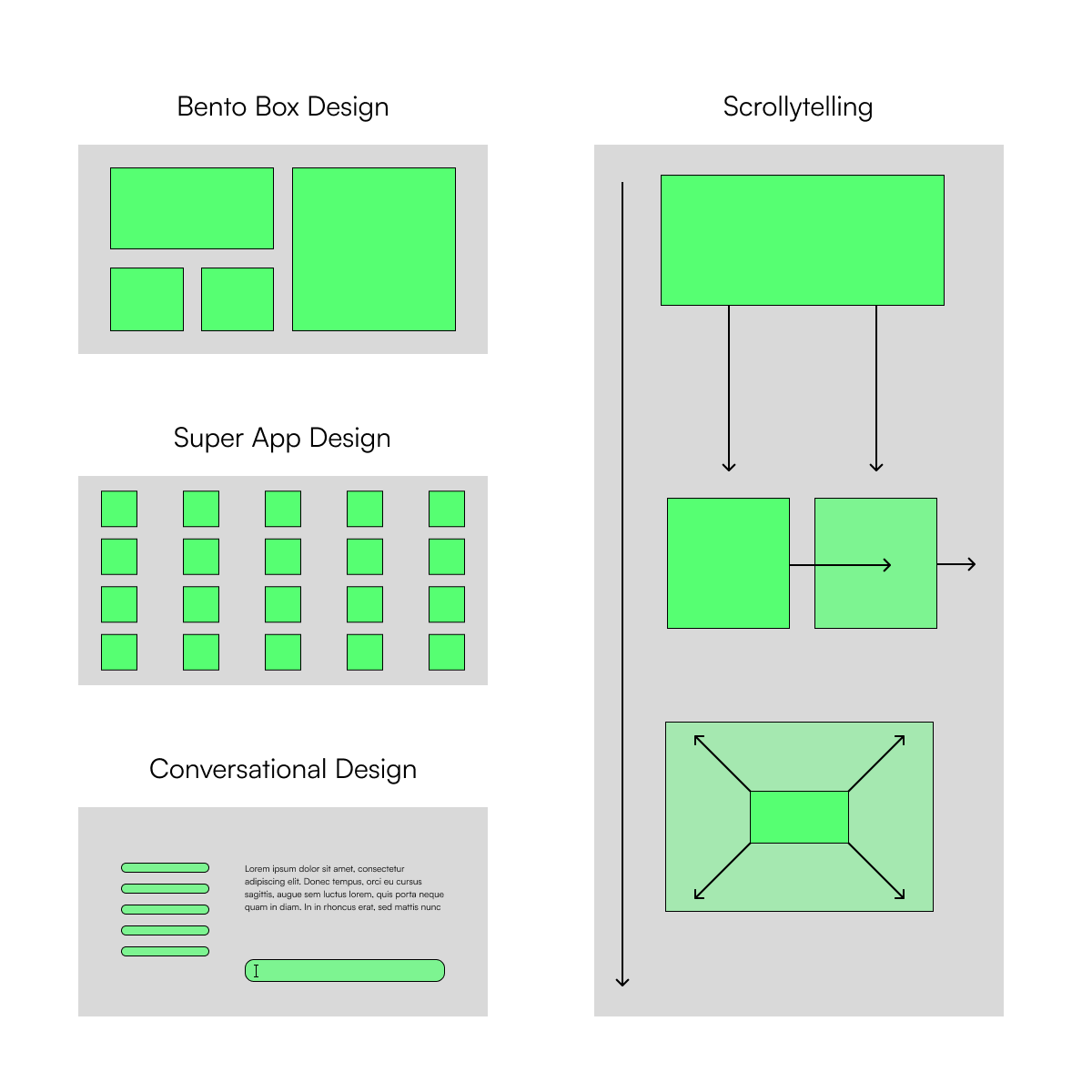
Bento box design
The bento box is a classic, but it’s finding newfound popularity in recent years, and for good reason.
Bento box design and AI-segmentation
We’ve already written some blogs on bento box design, but it's worth summarising the continued relevance of this interface layout. Bento box design refers to modular, self-contained elements which are arranged together on the screen. These modules can be “mixed and matched” to create different combinations for the end user.
As Claire Smith has pointed out previously, this makes this layout system perfectly suited to AI segmentation. Once users are categorised into one persona or another, AI tools can then pull together prebuilt modules into a bespoke interface that perfectly matches their specific needs. And since each component is designed to be modular and interchangeable, AI can do this without damaging the visual appeal of the site.
Dynamic and modular design
We’re also starting to see bento box layouts being combined with motion and animation, leading to highly dynamic interfaces that reward user interactions. Again, bento box layouts are well-suited for this function, as each individual component can easily grow, shrink, or transform in shape. This also offers a way of incorporating motion and interaction into designs focused on pagination, which are typically more static than their scrolling counterparts (more on this later!).
Super-app layouts
The success of “super-apps” in many Asian economies highlights the functionality of their information-dense interfaces, and suggests their potential for western audiences.
The Super-app in global perspective
The term super app refers to “do-it-all” applications that allow users to manage everything from communication, navigation, shopping and payment within one platform. First popularised in China, common examples include WeChat, Grab, and Alipay. Given the range of services contained within one platform, the interfaces of these apps are dense with information, especially compared with the minimalist solutions more common in Europe and the USA. That said, their popularity indicates that these interfaces are functional and effective (if not exactly fashionable!).
Interconnected and interchangeable
There are other reasons why super-app interfaces may be on their way to western users in the near future. The concentration of services within unitary platforms has been outlined as a goal by most American tech giants, with Elon Musk going so far as to describe X (formerly Twitter) as an “everything app” in 2023. More recently, Google, Meta, and ChatGPT have all taken steps to incorporate e-commerce functionalities directly into their platforms, rather than sending users to vendor websites.
In this context, the super app interface offers a solution to present interconnected functionalities, and allows for the flexible introduction of new services over time. Don’t be surprised to see your screens getting a little bit more cluttered as a result.
Conversational interfaces
AI tools make conversation a viable element of modern interfaces, requiring less fancy visuals but deeper thinking about user needs.
What is conversational UX design?
An interface is simply the medium through which you access information. In a digital context this was traditionally a visual layout, but advances in AI allow information to be presented in a conversation form. As users become accustomed to using tools such as ChatGPT, we can incorporate similar interfaces onto our own websites, encouraging users to ask questions rather than navigate through clicks and scrolls.
Where can conversational design add value?
Whilst this tool will make the most of breakthrough AI technology, it won’t be an obvious upgrade on traditional UI design for many websites. Conversational interfaces rely on effort and engagement from users to provide relevant information, which in many cases simply adds friction for no reason.
However, as a tool for providing context and deeper information, conversational elements are extremely useful and can deliver significant improvements to the user experience. When paired with structured data such as schema markup, conversational components can also strengthen SEO performance and localisation, helping pages appear more prominently for voice-based or question-style searches.
Scrollytelling experiences
In one respect, scrolling is making a comeback. Scrollytelling solutions deliver highly engaging experiences that respond to user behaviour.
What is scrollytelling, and where should it be used?
Scrollytelling merges narrative and interaction, turning static content into a guided story that unfolds as the user scrolls. It’s particularly powerful for brand storytelling, data visualisation, and campaign landing pages that rely on emotional engagement. When executed effectively, scrollytelling helps users absorb complex ideas through motion, animation, and sequential structure rather than through text alone.
Scrollytelling is not always the best approach, and is best used in moments when story and message align. The best examples blend visual choreography with concise copy, maintaining attention without overwhelming the user.
The continued relevance of human creativity
Interestingly, scrollytelling goes against the tendency towards modularity and flexibility described above. Instead, it relies on human expertise in building highly-specialised solutions, neglecting AI functionality in the process. The success of these designs is a testament to human creativity and storytelling, both of which will be hard to replace when creating effective brand narratives.
Competition or co-existence? The future of web interfaces
The coming years will likely bring an expanded palette of interface types rather than a single dominant model. Bento box layouts, super-app structures, conversational components, and scrollytelling techniques will all continue to evolve, intersecting in new ways across different industries.
As always, the most effective designs will begin with the needs of the end user, and will work backwards towards a technical and visual solution. Given the variety of users and requirements across industries, it won’t be a surprise to see a diverse range of interfaces blossom simultaneously.
At Kooba, we’re excited to see how these trends develop, and even more so to shape what comes next in the ever-changing landscape of digital design. You can read more about Kooba's design philosophy here.