






WebGL allows complex animations and 3D models to be smoothly loaded on websites. It provides web developers and designers with an ability to add motion and engagement without affecting performance and load times.
What is WebGL?
WebGL is a tool used to generate 3D effects and animations within a web browser. Traditionally these features would be generated using conventional HTML and CSS code, which employ a user’s CPU. However, whilst a CPU is well suited for creating logical and simple layouts, it can struggle when asked to quickly create and animate 3D models.
WebGL solves this issue by connecting a website to a user’s GPU, which is specifically built to run large numbers of calculations simultaneously. A device’s GPU is often used to run video games and other applications, as it is perfectly suited to 3D modelling and animation.
Advantages of WebGL development
WebGL allows for visually complex websites to load quickly and run smoothly for every user. Whereas traditional CSS development faces performance tradeoffs when integrating animations, WebGL can overcome these by using GPU rather than CPU hardware. In other words, we get to have our cake and eat it too.
WebGL is particularly transformative when it comes to interactive 3D designs, as it can model and generate these “stages” efficiently within your browser. This allows for user experiences that are distinct from traditional 2D designs, and which users can navigate in multiple directions with ease. These experiences can transcend some of the traditional limits of web design, and can be highly engaging and entertaining for users.
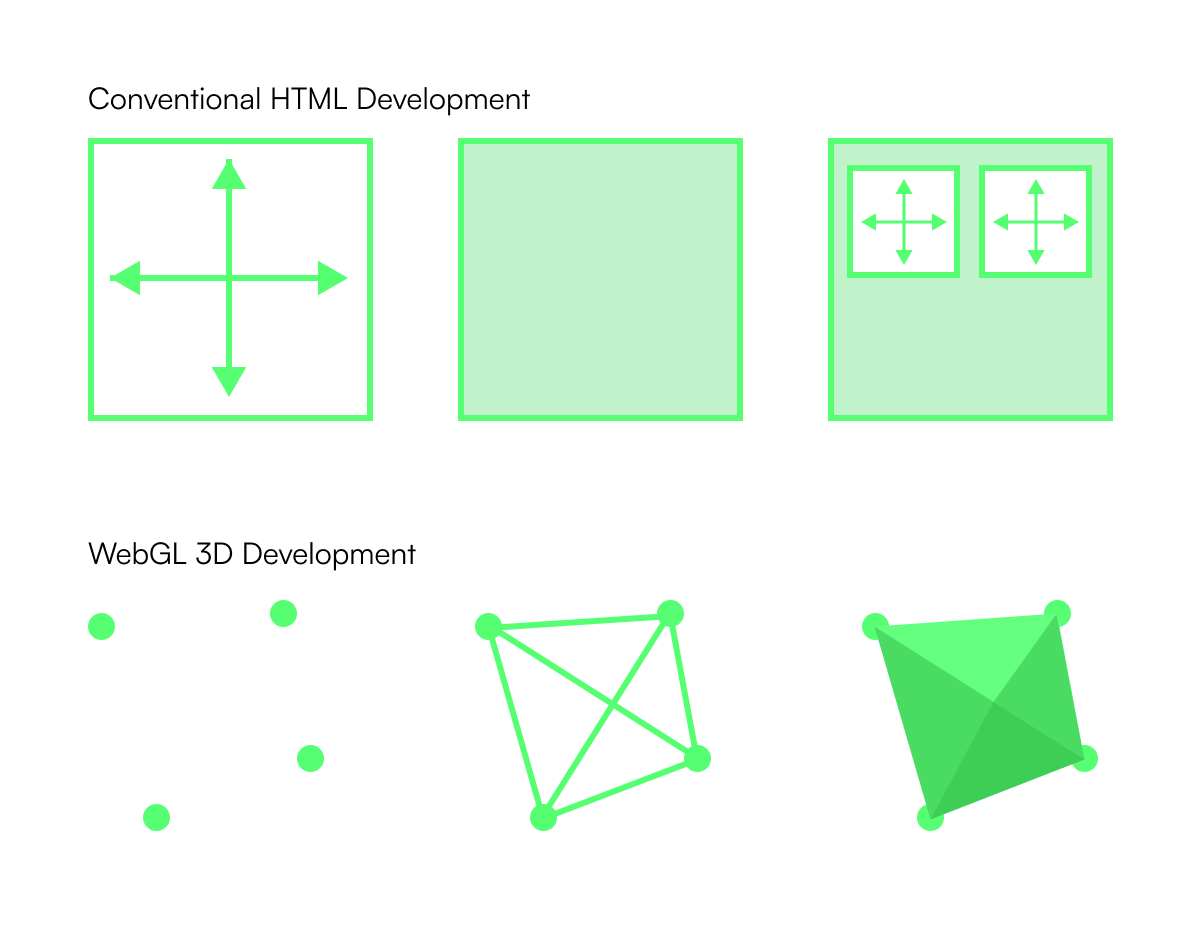
Issues with WebGL development
WebGL uses a very different set of terms and language to HTML based code. Rather than defining flat boxes and components, designers and developers instead need to think across three dimensions. Firstly, points are defined across three axes, then triangles are created across these (AKA “primitives”) which are then exposed to lighting and colour (creating “fragments”). Finally this 3D model is rasterised back into a 2D format so that it can be displayed on a 2D screen.
Sounds complicated, right? This is a workflow which is unfamiliar to most web design and development teams, and this makes incorporating WebGL challenging, even where it can add real value.
WebGL also speaks a language which browsers can struggle to understand. Text and images contained within a WebGL canvas will typically be neglected by search engines crawlers and screen readers, who are instead searching for neatly formatted semantic HTML. This is one reason why websites using WebGL tend to use a hybrid approach, with only the 3D elements themselves being loaded using WebGL, and the rest of the site using conventional SEO-friendly HTML.
How WebGL can improve user engagement
Ultimately, WebGL is a tool like any other. Even if it is not always necessary or relevant, it can provide highly engaging and interactive experiences when used correctly. Developers and designs can embrace these new possibilities, although they must retain a focus on accessibility, SEO, and mobile functionality in the process.
WebGL is an extremely exciting technology, and one we are super keen to embrace here at Kooba.