






Unless you’ve been living under a rock, you’ve heard a lot about GEO and AI visibility over the last year or so. And for good reason. 37% of users now go to AI tools when beginning a search, almost as many as use traditional search engines. These tools work in fundamentally different ways to search engines, and businesses who surface on them are now enjoying outsized gains as a result.
But even if we can observe the obvious value of GEO, it can be hard to make sense of its relative value in relation to SEO. After all, most websites still receive the large majority of their traffic from traditional search engines.
To put all this in perspective, I’ve sketched a loose timeline, stretching back to the advent of commercially available LLMs, and extending out over the next 5 years of potential AI adoption. This is all speculation of course, but should give a rough sense of where and when investment into GEO will provide the most value to your digital platform.
The past: The old order
Let’s start by thinking about the existing landscape of digital marketing prior to the arrival of traffic from AI sources. In this environment, driving traffic to your website was mainly a case of traditional SEO. By building a higher-performing site and optimising for the right keywords, you could bring in organic traffic, which was then augmented by paid SEO campaigns. You might also gain direct traffic from social media and third-party websites and directories.
This wasn’t always easy to do, but it was quite simple to understand what an effective website looked like. That is, until AI visibility became a consideration.
The present: The Wild West
In the past two years, traffic has begun to trickle onto websites from AI sources. These users still make up a very small percentage of total visitors, but they contribute a disproportionate volume of leads and revenue. Because users tend to use LLMs when they are closer to making a purchase, they enter your website with higher intent, and convert at much higher rates. As one recent study by Shopify found, users from AI sources are more than twice as likely to land on a product page, 50% more likely to convert, and typically spend more when they do.
As the below graph shows (based on data from over 200 companies) an increase in traffic from AI sources is allowing for revenue to rise despite a fall in overall traffic. This is due to the higher relative value of AI-sourced traffic.
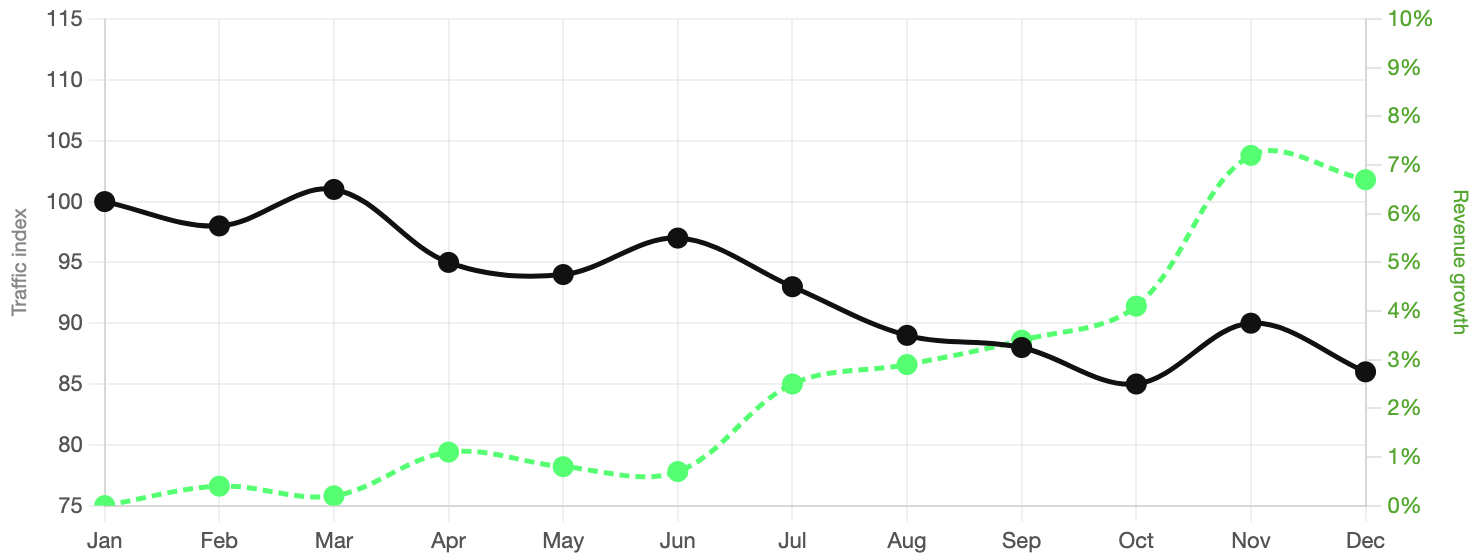
Of course, this data also illustrates a wider decline in organic traffic. As AI overviews become pushed onto a larger and larger audience, we’ve seen a dramatic rise in “zero-click” traffic, with queries being answered before users even enter a site.
A decline in organic traffic and the high-intent of AI traffic means that investments into GEO are highly lucrative. By increasing the visibility of your brand within LLMs, you can find immediate gains in high-value traffic. When the alternative is the diminishing returns of traditional SEO, this is an obvious choice for most businesses.
The future: A new balance
So if the present moment represents a window of opportunity for investing in GEO, when will this window close? To answer this, we need to think about the underlying value of traffic from traditional and AI sources. Right now, organic traffic still makes up the bulk of visits for most sites. As such, declines in this traffic will likely be driven by a loss of low-intent users. This means that as volume decreases, quality will slowly increase.
The inverse is true of traffic from AI sources. In this case, increases in visitors will increasingly consist of lower-intent users seeking information rather than immediate purchases. So rising volume will go hand in hand with falling value.
In the long-run, this means that the ROI of investments into GEO and SEO will equalise after several years of GEO overperformance. Within a few years, AI visibility will have been saturated by your competitors, just as SEO is now.
The takeaway: A golden opportunity
GEO still represents a competitive advantage that can provide significantly improved ROI compared to SEO. Over the next two to three years, businesses which dominate their industry within LLM queries will receive outsized gains in leads, revenue, and brand perception.
After this window of opportunity closes, the relative value of SEO and GEO will begin to equalise, and we’ll return to another stable status-quo.
To learn more about GEO, and start building your own brand’s visibility within LLMs, just reach out to our team today. We’d love to speak with you!