






AI search has already changed the way people discover information online.
Instead of typing some keywords into a traditional search engine, users can now ask full contextual questions with responsive AI tools. These searches are more conversational, more specific and often closer to a real decision making moment.
This means businesses need to think beyond traditional rankings. To gain access to this highly-valuable traffic from AI sources, you’ll need to be mentioned and cited within their answers. This means that your website needs to give AI tools enough trustworthy, structured and useful information to include your business in an answer.
Here’s how you can improve your AI visibility, and gain more searches and traffic from AI sources.
The basics of GEO
Generative Engine Optimisation, or GEO, is the process of improving your website so that AI search tools can better understand, interpret and reference your content. It shares some principles with SEO, but the focus is slightly different. Rather than optimising only for keywords and rankings, GEO focuses on gaining positive brand mentions and awareness.
In practical terms, this means making sure your website clearly explains who you are, what you do, who you help, where you operate and why your expertise matters. It also means answering the kinds of detailed questions your audience is likely to ask AI tools. The stronger and more complete your content is, the easier it becomes for AI systems to connect your business with relevant user queries.
Improving your content
Well-written content is one of the most important factors in winning AI search traffic. AI tools are designed to provide useful answers, so they are more likely to draw from websites that explain topics clearly and provide meaningful detail.
To improve your content, focus on answering real audience questions in a clear and helpful way. Build out detailed service pages, sector pages, case studies, FAQs, thought leadership and location specific content where relevant. Use plain language, provide evidence of your experience and explain the problems you solve in practical terms. The goal is to create content that is genuinely useful to humans, while also being easy for AI tools to understand and trust.
Technical optimisation
No matter how strong your content is, your technical setup is still vital when improving AI visibility. AI tools need to be able to access, crawl and understand your website efficiently, and your site is slow, difficult to navigate, poorly structured or missing key technical signals, it becomes harder for both traditional search engines and AI systems to interpret your content properly.
A technically optimised website should have clean code, fast loading speeds, strong accessibility foundations, clear page structures and well implemented schema markup. These elements help search engines and AI tools understand the relationship between your pages, services, locations, people, case studies and areas of expertise. All of these features will also provide spill-over benefits to your users, as your site will load faster and be more digitally inclusive and usable.
A new role for your website
To get the most out of AI search it is not enough to simply optimise your website as it exists today. Instead, you’ll need to think of your site as fulfilling an entirely new set of functions. Whereas in the past you could rely on human visitors to “read between the lines” of basic content pages, it is now necessary to produce and publish more information than ever before.
On the one hand, the quantity of information hosted by your website is increasingly important. To rank effectively across a wide range of long-tail user prompts, you’ll need more detailed service pages, more FAQs, more comparison based content, and more case studies. In other words, more everything. This means a larger website that allows for content to be uploaded and edited quickly and easily.
On the other hand, the quality of this content and information needs to be more accurate and authoritative than ever before. Everything uploaded within your website should be aligned with your brand, well-sourced, and clearly interlinked with other content. Not only will this improve the perception AI tools have of your business, it will also make you seem more trustworthy, and hence improve your total volume of mentions.
Content design and the author experience: The unsung heroes of GEO
So how can your website help you produce large volumes of high-quality content?
The answer comes down to content design and AX (author experience) design.
Content design for GEO
Content design is an important part of the UX process. It focuses on shaping the content structures, modules and page formats that help users understand your business, services and value clearly.
This could include blog layouts, case study templates, statistics modules, service page sections, FAQs, comparison blocks or other bespoke content formats relevant to your brand. By designing these collaboratively with your team, we can make sure the website gives you the right tools to present information clearly, consistently and persuasively.
This also supports AI visibility. By understanding what information is being cited, surfaced or expected in AI search results, we can help bring that content onto your site in a structured, user-friendly way. This improves the experience for users while also giving AI tools clearer, more useful content to reference.
AX design for GEO
AX design is a sub-section of UX design. It involves all the decisions that go into making the author experience more flexible, streamlined, and efficient. For many web design projects, this means building a CMS that matches the needs of each publisher or content manager. From a GEO perspective, a streamlined author experience means that each piece of content can be easily published, interlinked, edited, and replicated. This saves time for your team, and increases the volume of content that can be produced.
At Kooba, we specialise in Craft CMS, which is perfectly suited to this task. You can read more about Craft CMS here: https://www.kooba.ie/journal/why-content-teams-love-craft-cms
Where to start
Before you can begin to improve your AI visibility, you need to understand it. Reach out to Kooba today to receive a free AI visibility audit, tailored to your business and your competitors.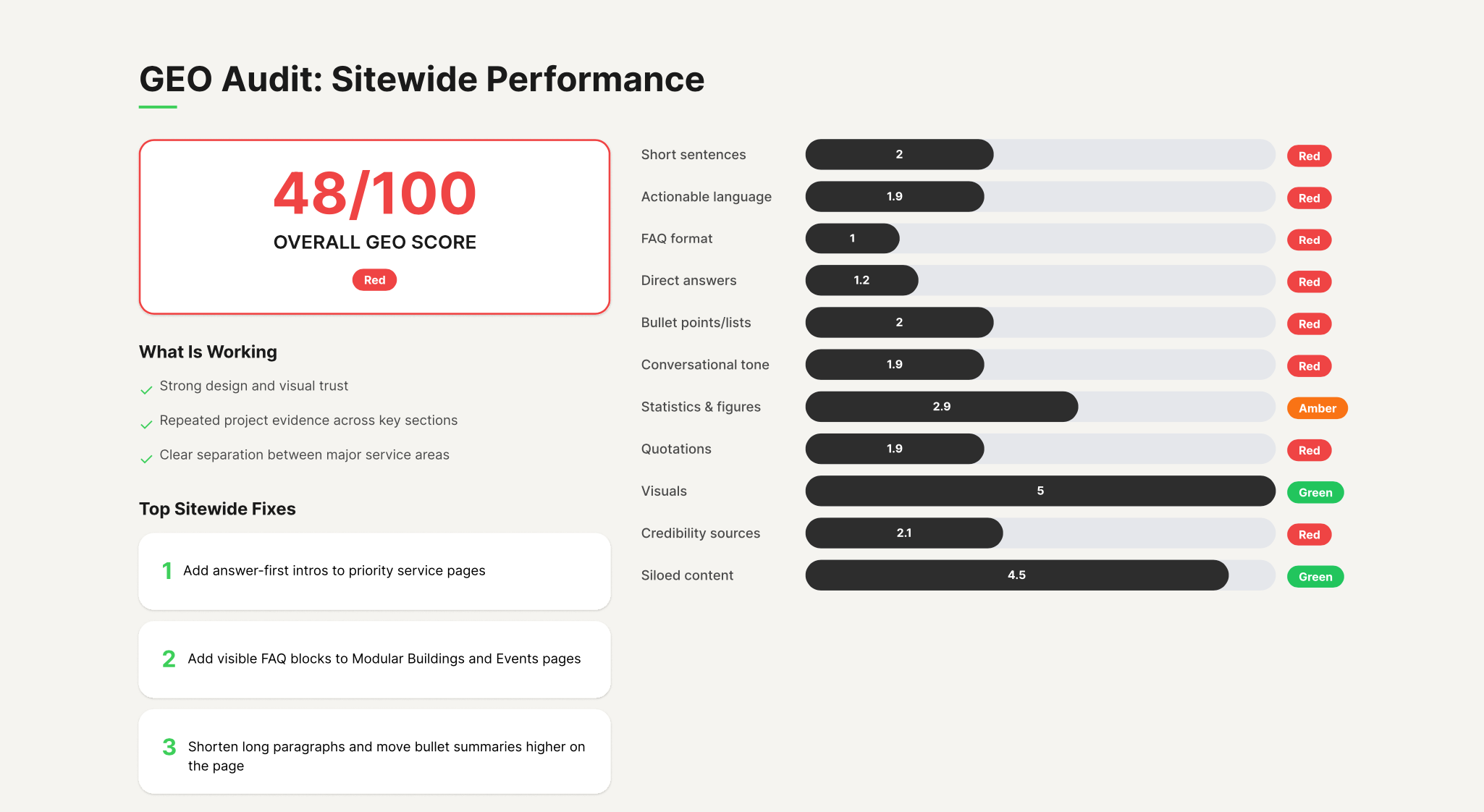
Once you know how your business is mentioned on these tools, you can start improving your content, technical setup, and CMS.
To learn more about the ways that LLMs can reach your website, you can see Sadie McMaster’s blog on the subject here: https://www.kooba.ie/journal/how-do-llms-reach-your-website