






Every day, members of your target audience will make queries related to your brand on tools such as ChatGPT, Claude and Gemini. As we’ve written about in the past, improving your AI visibility can have significant benefits for your business.
However, to improve your website and content, it can help to have a greater understanding of how these large language models actually search the internet and reach your website. In this article I’ll break down how LLMs engage with your content and feature your brand in their responses.
What is an LLM?
A large language model (LLM) is a type of AI system trained to understand and generate human language. These tools can interpret questions, recognise patterns in text and produce responses that feel natural and conversational.
Importantly, an LLM does not “know” information in the same way a person does. Instead, it has been trained on very large collections of text and learns relationships between words, phrases, topics and ideas. Because of this, it may need to find more context or information when it receives an unfamiliar prompt.
When this happens, the LLM will use a search agent to find more relevant content. This is often referred to as retrieval augmented generation, or RAG.
The AI search process: Step by step
1. A query is asked
To begin with, a user will make a query that is related to your business, product, or industry. Usually, they’ll have given the model some context towards their requirements ahead of this request.
2. The model categorises the query
The LLM then needs to decide whether to search the internet or not. Oftentimes, the query can be answered quickly using existing training data, which may include older information about your brand.
Because it is more costly and time consuming to expand the search to the internet, AI tools may only do this when they know it is crucial for answering their current query.
3. An AI agent begins searching the internet
If the query requires up-to-date information that is missing from the LLM’s training data, a search agent will begin making searches via traditional search engines such as Google. Typically, it will be seeking out only the specific information that it needs to complete its query.
Unlike traditional search engines, which understand the entire internet in an holistic manner, AI search agents often rely on what third-party directories and review platforms say about your brand. They will also be willing to quickly navigate to your site if you have written content directly matching the search they are performing (even if it is not linked to elsewhere).
4. The agent navigates through your website
Once this agent reaches your site, it will go through it to gather relevant information. It moves in much the same way as a human user, and uses the HTML code and ARIA tags of your website to understand the layout of content. Like most web crawlers, it will also analyse the structure of your website and your content.
In general, clear HTML structure, headings, internal links, metadata, schema markup and accessible labelling can all make it easier for machines to understand the structure and purpose of your content.
Because this agent is a bot, it may struggle with gated content, complex forms, CAPTCHAs, interactive tools, account areas or journeys that require user input.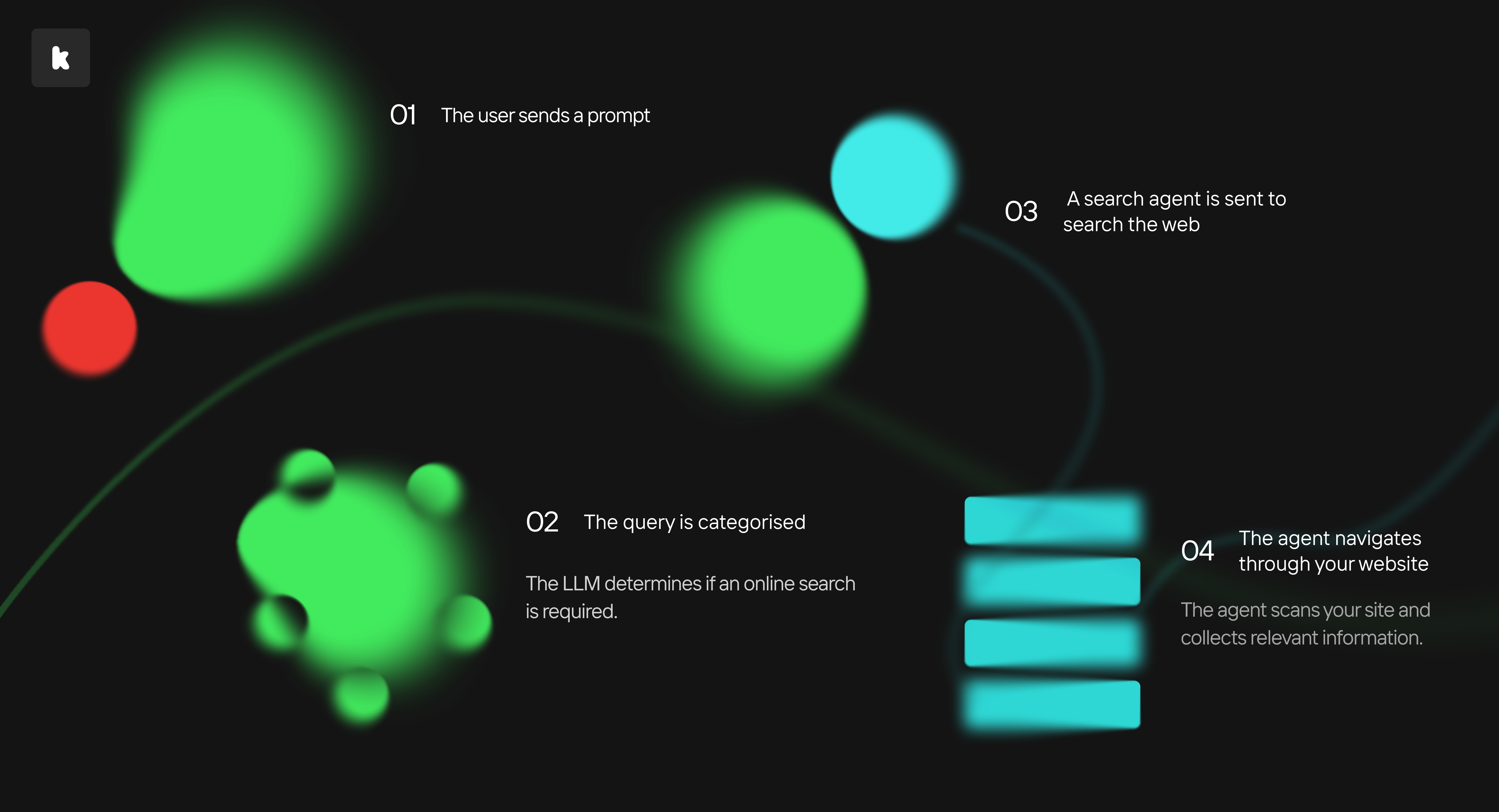
5. The agent returns to the conversation with new information
Once the search tool finds useful material, the relevant snippets, page content or source details are passed back into the model’s original conversation.
6. Both sources of information are combined
For many queries, the LLM will only require a portion of its response from an online search, with the rest being answered using training data and conversation history. The information gathered online will then be combined with this, creating a complete response for the user.
7. Your website is cited in the response
As the LLM responds, it will typically include a link to your website to cite the source of its information. Depending on how the information is sourced, the link will bring users to either your homepage or the page containing the information.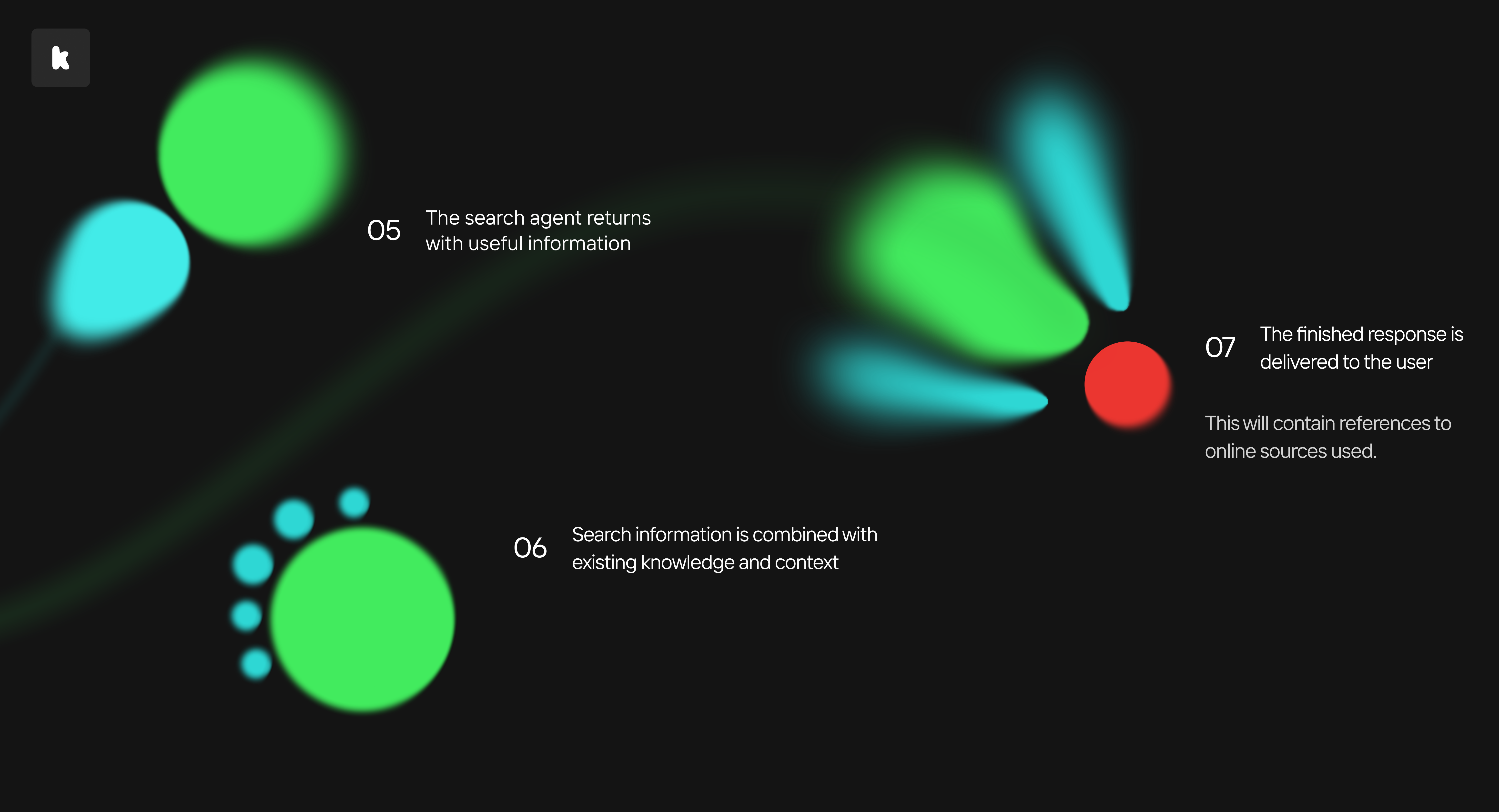
Where you can build AI visibility
How can you make sure that your website is referenced in AI responses? There’s a wide range of strategies that you can use to increase your odds of being cited.
Firstly, you can produce content that matches the queries that your audience may ask large language models. Informative and useful content written in accessible language will make it easy for LLMs to take snippets for use elsewhere. Likewise, if you can produce unique insights, data, and evidence, LLMs will use these to answer specific queries.
Secondly, you can ensure that the technical framework of your website can attract and welcome LLM traffic. A clear and rational structure, semantic HTML, and relevant schema can all make it easier for search agents to retrieve content from your pages.
To learn more about AI visibility, check out our full overview here: https://www.kooba.ie/journal/how-to-maximise-ai-visibility-in-2026
Get started on AI visibility today
If you’d like to build a website that attracts and converts traffic from LLMs, just reach out to our team today, we’d love to hear about your specific requirements.